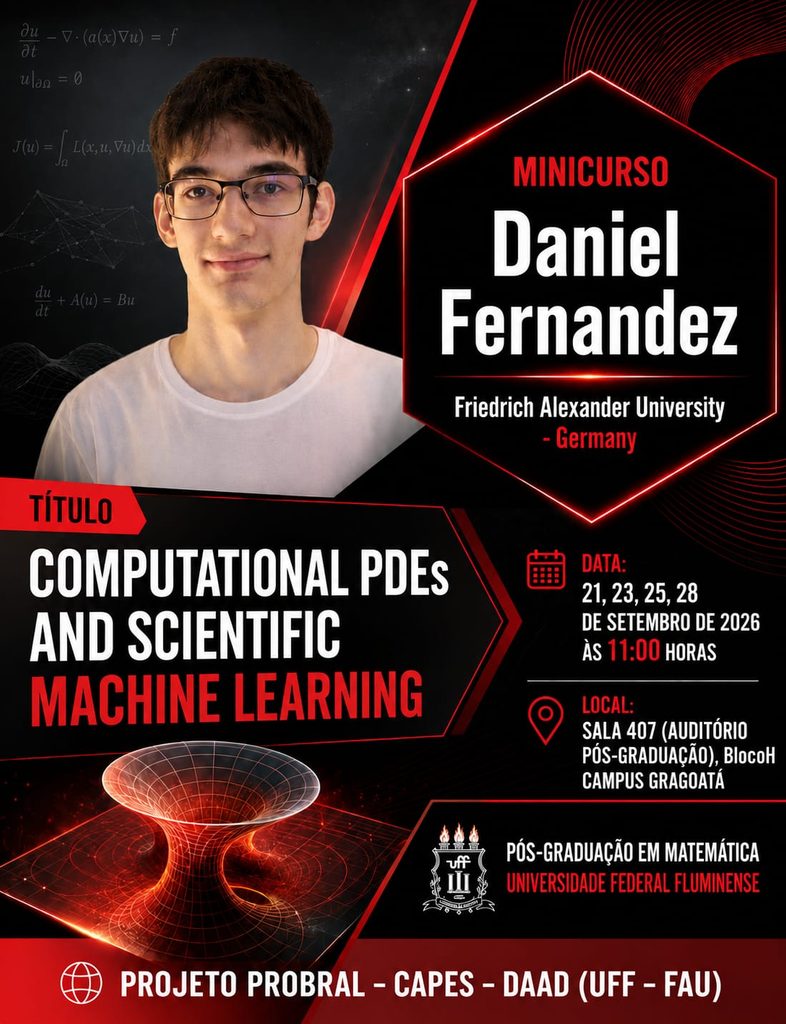
Nos dias 21, 23, 25 e 28 de setembro será realizando na UFF o minicurso “Computational PDEs And Scientific Machine Learning”, que vai de 11h às 13h, no auditório da Pós-Graduação (sala 407, bloco H, Gragoatá).
Este minicurso faz parte do projeto PROBAL-CAPES-DAAD entre a Universidade Federal Fluminense e a Friedrich Alexander Universitat-Germany.
Abaixo os detalhes do curso e em anexo o cartaz.
Abstract: “This graduate course explores classical and machine learning approaches to the numerical solution of partial differential equations (PDEs), combining mathematical foundations with practical implementation.
The first part develops the basic theory of the finite element method (FEM), emphasizing weak and variational formulations and their finite-dimensional discretization. We then translate these concepts into computational PDE solvers using FEniCS, establishing a foundation for understanding and evaluating computational methods.
The second part introduces the fundamentals of neural networks and their use in approximating PDE solutions, with a focus on the Deep Ritz method and physics-informed neural networks (PINNs). These approaches are examined through their mathematical formulations, training objectives, and numerical behavior. Particular attention is given to their theoretical limitations and practical caveats, especially the coercivity gap and the extent to which minimizing a training loss provides meaningful control of the solution error.
Throughout the course, benchmark PDEs and a selected applied problem provide a common framework for numerical experimentation and comparison between finite element and neural approaches. By connecting variational theory, numerical analysis, and scientific machine learning, the course allows participants to implement PDE solvers and critically assess the accuracy, stability, and reliability of their results.”
Esperamos vocês!